








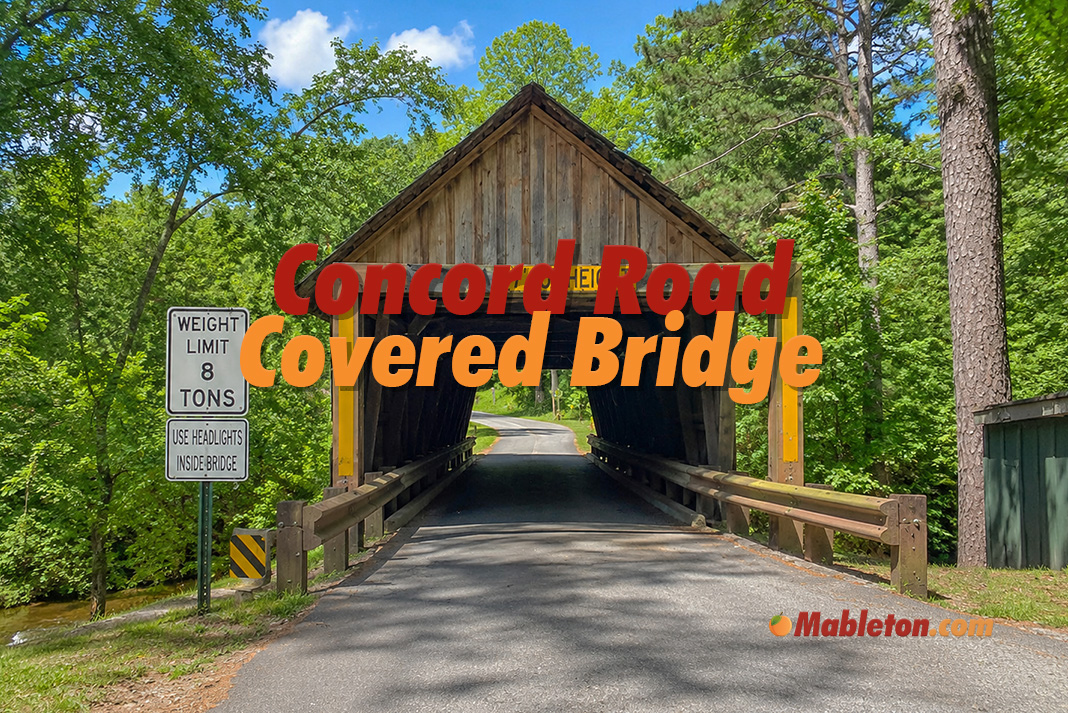
Some historic sites ask visitors to park, read a plaque and behave. The Concord Road Covered Bridge asks drivers to notice several warnings, check the height of their vehicle, yield to approaching traffic, and enter a dark wooden passage built for a very different century.
The bridge crosses Nickajack Creek on Concord Road near Mableton, along the Smyrna and Mableton border. It measures about 131 to 133 feet long, has a clearance of seven feet and receives more than 8,000 vehicles a day. It is the only covered bridge remaining in Cobb County and one of the busiest historic covered bridges in Georgia.
It has endured floods, a Civil War battle nearby, arson attempts, repeated reconstruction, and a modern parade of rental trucks that had more confidence than clearance.
A Crossing Built Around Water Power
The bridge was built for a working mill district along Nickajack Creek, where moving water powered gristmills, sawmills, cotton mills, and the Concord Woolen Mill.
Martin L. Ruff moved into the area after receiving property through Georgia’s 1832 lottery, which opened Cherokee territory to white settlement shortly before the forced removal of the Cherokee people. Ruff later acquired the gristmill property in 1856. The mill ground wheat and corn, and the creek’s dam and race directed water toward its machinery.
A crossing existed at the site by the 1840s. Local historical documents attribute an 1848 flat deck bridge to Ruff, Concord Woolen Mill owner Robert Daniell, and state senator John Gann. The stone masonry supports associated with that early crossing remain beneath later versions of the bridge.
The bridge connected farms, homes, and mills on both sides of Nickajack Creek. In an era before paved roads and gasoline engines, losing a bridge to floodwater could cut off customers, grain wagons, and supplies.
War Reaches Ruff’s Mill
On July 4, 1864, the Battle of Ruff’s Mill brought the Atlanta Campaign directly into the area. Union troops attacked Confederate defensive positions near the mill, forcing the Confederate line back toward the Chattahoochee River. Fighting continued around Nickajack Creek in the following days.
The covered bridge seen today should not be confused with the crossing used before or during the battle. The National Register nomination states that the earlier bridge was probably destroyed during the fighting. The bridge site survived. The timber above it did not remain frozen in 1864.
So When Was the Bridge Built?
The familiar answer is 1872. The 1980 National Register nomination identifies a covered bridge constructed that year by Martin L. Ruff and Robert Daniell to replace the earlier crossing. It also describes the bridge as part of the mill complex that grew along the creek.
Later newspaper research adds another date. Cobb County advertised for a modern bridge at Ruff’s Mill in June 1891, describing a span of about 135 feet. Reports that autumn said John Wesley Ruff had begun the bridge, then announced in November that the new covered bridge had been finished and painted. The Friends of the Concord Covered Bridge Historic District considers the bridge’s present appearance likely connected to that 1891 project.
The apparent disagreement is less dramatic once the life of a wooden bridge is considered. Floods, decay, heavier traffic and repairs led to repeated rebuilding. The Concord bridge is best understood as a historic crossing renewed in stages, with parts from different periods, rather than a single untouched object placed over the creek on one tidy date.
Why Cover a Bridge?
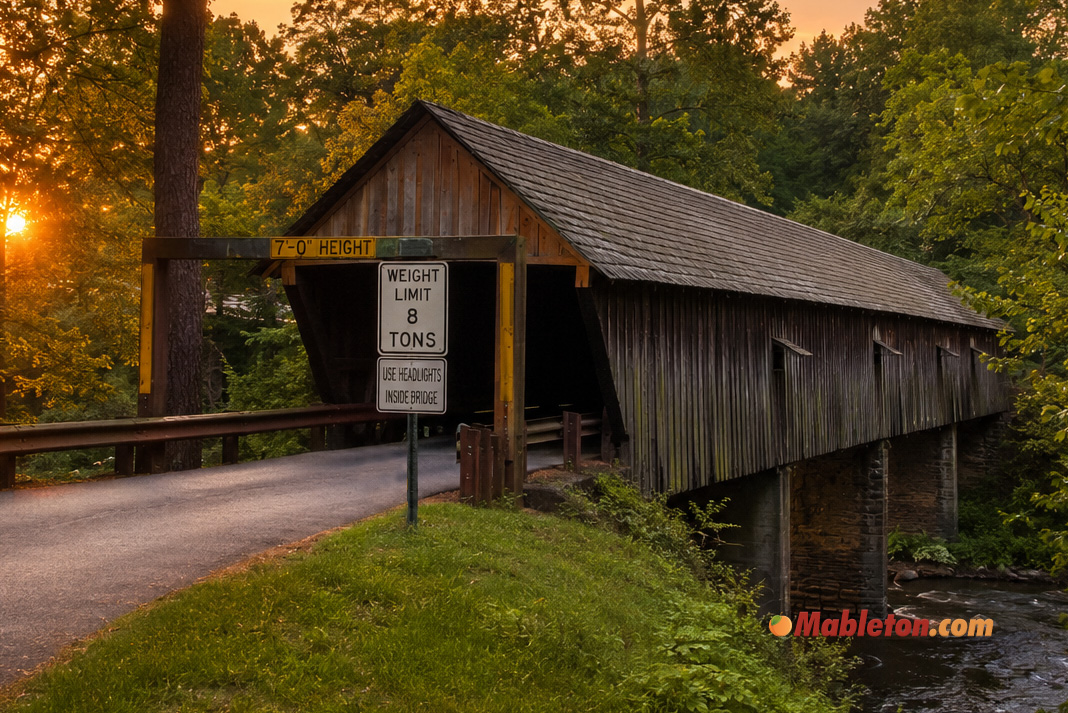
The roof was built to protect the bridge, not the travelers. Wooden trusses exposed to rain and repeated moisture deteriorated quickly. Siding and roofing reduced weather damage and extended the life of the main structural members, while lighter exterior boards and shingles could be replaced as needed.
The Concord bridge has a Queenpost truss made from heart pine timbers and iron rods. It measures 133 feet long, 16 feet wide and 13 feet high. Thick wooden planks form the floor, vertical boards enclose the sides and stone masonry support the span. Steel beams and concrete piers were also more recently added in order to handle automobile traffic. The wooden exterior maintains its nineteenth century appearance, but the bridge beneath the shingles has modern reinforcement.
Floods, Fire and Repairs
Flooding repeatedly tested bridges along Nickajack Creek. Newspaper accounts reported that a county bridge at Ruff’s Mill washed away in 1880 after heavy rain destroyed the mill dam. A new bridge followed, and further strengthening was done in 1896.
Cobb County made major repairs in 1963, installing steel beams, a new wooden floor and two concrete piers. Arsonists tried twice to burn the bridge in 1964, causing limited damage. Soon afterward, the county’s other surviving covered bridge over Sope Creek was destroyed by fire, leaving the Concord bridge as Cobb’s lone example.
The Concord bridge entered the National Register of Historic Places on November 24, 1980, as part of the Ruff’s Mill and Concord Covered Bridge property. Cobb County created the larger Concord Covered Bridge Historic District in 1986, its first locally designated historic district. The district also includes historic houses, a railroad trestle, and remains associated with the Concord Woolen Mill.
Repairs continued. A cedar shake roof was added in 1983. A major four month rehabilitation in 2017 cost about $803,000. Crews straightened a bridge that had shifted nearly 12 inches out of plumb, installed new support elements, and disguised modern steel so it blended with the wood. The completed project received engineering recognition for its sensitive planning and design.
A June 2026 Cobb County SPLOST report shows the most recent update to the bridge. The project involves a $500,000 drainage and lighting project, scheduled for completion by December 31, 2026.
The Seven Foot Problem
The bridge’s greatest modern enemy is not floodwater or fire. It is the driver of a tall vehicle who believes several clearance signs are just suggestions.
Cobb County has installed warning signs, height activated flashing signals, hanging pipes, protective beams, and a truck sized turnaround. Drivers still strike the barriers. County officials reported that rental vans, work trucks, and vehicles towing trailers account for many incidents, often after drivers followed a navigation app and ignored the warnings.
The protective beams absorb much of the damage before a vehicle reaches the historic wood. They have been hit dozens of times, and another incident involving a truck and car carrier led to repairs in May 2025. The system can look excessive until a box truck arrives and provides a live demonstration.
Vehicles taller than seven feet should use the nearby detour along Hurt Road and South Hurt Road. The bridge also has an eight ton weight restriction.
Visiting the Concord Road Covered Bridge
The bridge remains open to vehicle traffic, but the road narrows sharply at the crossing. Visitors seeking a longer look can use designated parking at the Concord Road trailhead of the Silver Comet Trail or at Heritage Park.
Heritage Park follows Nickajack Creek through wooded terrain and includes access to the Concord Woolen Mill ruins, historic features and the Silver Comet Trail. The park has free admission and parking. Its trail extends about 1.7 miles in one direction, with boardwalks and creek views along the route.
The Concord Road Covered Bridge has survived because generations repeatedly chose repair instead of replacement. Its history appears in stone piers, wooden siding, steel reinforcement, cedar shingles and the battered warning beams at each entrance. Cobb County has newer bridges, wider bridges, and bridges with fewer police reports. None has a story quite like this one.
Address:
Heritage Park
60 Fontaine Road
Mableton, GA 30126
Concord Road trailhead
140 Concord Road SE
Smyrna, GA 30082